

Artemis-02 Crew Return Ceremony. Photo Credit: NASA/David DeHoyos
Breaking the Firmament
How a Lunar Mission Became a Historic Moment of Representation, Worship, and National Reflection
by Latoya Hazell-Alcide
The heavens declare the glory of God; the skies proclaim the work of His hands” (Psalm 19:1).
A Journey Fifty Years in the Making
More than fifty years passed between footsteps on the Moon. The last time human beings traveled beyond Earth’s orbit toward the Moon was during Apollo 17 in December 1972. But the dream never disappeared; it waited.

That dream, known as the Artemis program, named after the twin sister of Apollo in Greek mythology, symbolized continuity between past achievement and future exploration. When Artemis II launched its crewed mission, it marked more than technological progress. It marked the reopening of a chapter that had been closed for more than half a century.

The message was this: Humanity was returning, not just to space, but to possibility.

Remembering the Cost of Exploration
Progress has always carried risk, and space exploration has never been without sacrifice. Before Artemis could rise, history demanded remembrance. Two tragedies shaped the modern understanding of space travel and safety.
  • In January 1986, the Space Shuttle Challenger disaster shocked the world. Millions watched as the shuttle broke apart shortly after launch, claiming the lives of seven astronauts. The loss was immediate, public, and unforgettable.
  • Seventeen years later, tragedy struck again. In February 2003, the Space Shuttle Columbia disaster disintegrated during re-entry into Earth’s atmosphere, again claiming seven lives.
Yet, from tragedy came learning because the result of investigations led to stronger systems, improved safety measures, and renewed humility about the risks of leaving Earth.

The message for us: Progress remembers sacrifice.
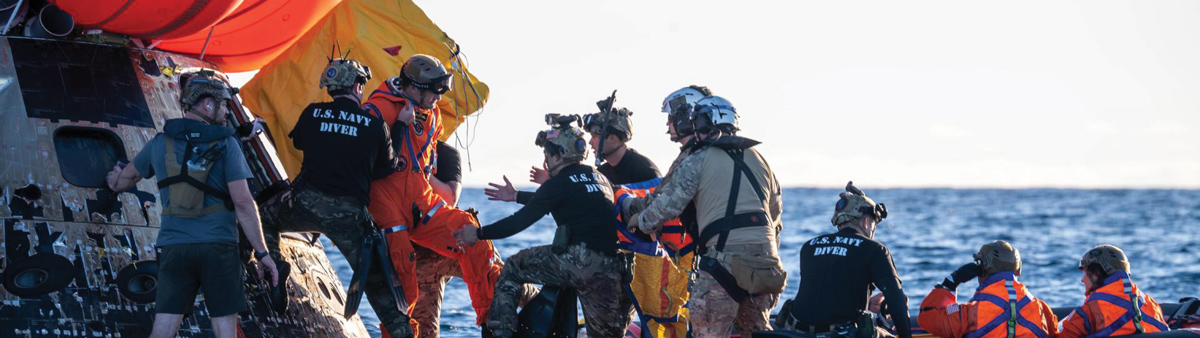
U.S. Navy divers assist individuals in orange suits near a floating spacecraft in the ocean.
Return. Recovery teams secure the Orion spacecraft after splashdown. Image Credit: NASA/Kevin Davis
From Apollo to Artemis – A Return to the Moon
In December 1968, the mission Apollo 8 became the first crewed spacecraft to orbit the Moon. That mission took place during one of the most turbulent periods in American history, a time marked by social unrest, war, and national division. Yet from lunar orbit, the astronauts did something remarkable. They read from the Book of Genesis. Across the world, millions listened as words of creation echoed through space:

“In the beginning, God created the heaven and the earth.”

In a divided time, space exploration became a moment of shared wonder.

During the Artemis II, astronauts carried more than equipment. They carried conviction, belief, and a witness of integrity through faith. Piloting the crew was Victor Glover, a Sunday school teacher known for openly expressing his Christian faith. Glover brought symbolic reminders of belief aboard the spacecraft, including Scripture and Communion elements. From deep space, messages were shared reflecting love for neighbor, stewardship of creation, and gratitude for the opportunity to explore. Their witness reminded the world that science and faith do not compete but they can, with the lens of God as scientist, complement one another.

The message for us: Science explains mechanisms, faith explains and believes meaning, and exploration in that space of belief opens doors for testimony.

A TIMELINE

From Apollo to Artemis — Humanity’s Return to Deep Space

1968 Apollo 8 Orbits the Moon
First crewed mission to circle the Moon.

1972 Apollo 17
Last lunar mission for more than fifty years.

1986 Challenger Disaster
Seven astronauts lost during launch.

2003 Columbia Disaster
Seven astronauts lost during re-entry.

2022 Artemis I
Successful uncrewed lunar mission.

2026 Artemis II
First crewed lunar orbit since the Apollo era.

Sustained by God – The Fragility of Life in Space
Human survival depends on elements so basic that they are often overlooked.
  • Without oxygen, life fades within minutes.
  • Without water, survival becomes impossible within days.
  • Without food, strength diminishes within weeks.
Scripture reminds us of humanity’s dependence in ways both spiritual and physical. Acts 17:28 declares, “For in Him we live and move and have our being.”
Astronauts understand this dependence in unique ways. Every breath in space depends on carefully maintained systems. Every drop of water is measured. Every ounce of food is calculated. Survival is never accidental, it is sustained. Close calls and near misses of disasters within the space program testify of the helplessness and non-existent means for survival if astronauts become lost in space, unable to return back to Earth on schedule. This reality echoes the spiritual truth found in Psalm 121:7-8:
“The Lord will keep you from all harm
He will watch over your life;
the Lord will watch over your coming and going
both now and forevermore.”
Space travel reveals the fragility of human life, but also the faith required to surrender that fragility into the hands of God.

The message for us: In space, survival depends on systems, but in faith survival depends on surrender. And both require trust.

The Power of a Name – Why “Integrity” Matters
Fact: Names matter. When the crew of Artemis II named their Orion spacecraft Integrity, they were making a statement about values as much as technology. Commander Reid Wiseman explained that integrity represents trust, honesty, and unity, qualities necessary for successful exploration. He noted that integrity is not a permanent condition, but a daily choice. As he observed, a person can be “in and out of integrity,” reminding us that character must be practiced continually.

The name Integrity connects directly to the spirit of Apollo 8, a mission remembered not only for scientific success but for its unifying message during a divided era. Just as Apollo 8 brought people together through shared wonder, Artemis II carries a similar hope, to unite humanity through exploration. This calls us to a higher thinking of integrity because Integrity represents more than a spacecraft. It represents cooperation among thousands of individuals working together across disciplines, nations, and cultures. Every system aboard the spacecraft depends on integrity, of design, materials, and human collaboration. In many ways, the spacecraft’s name becomes a mirror for society.

  • Without integrity, systems fail.
  • Without integrity, trust collapses.
  • Without integrity, unity becomes impossible.
Integrity does not stand alone, it is sustained by faith. Faith requires trust in what cannot always be seen, and integrity requires commitment to what must always be done. Engineers trust calculations, pilots trust systems, and mission teams trust one another. But beneath every layer of preparation lies faith, the quiet confidence that what has been built will hold, that what has been tested will perform, and that what has been entrusted will endure. Scripture reminds us:

“The righteous man walks in his integrity; His children are blessed after him” (Proverbs 20:7).

Integrity strengthens faith, and faith strengthens integrity. One shapes character, and the other sustains courage. And together, they form the foundation upon which great journeys are built. For astronauts, integrity means doing what is right even when no one is watching. For believers, faith means trusting God even when He cannot be seen. When integrity and faith work together, fear gives way to confidence, and uncertainty gives way to movement. And that is the message carried within the name Integrity:

The message for us With integrity and faith working together, the impossible becomes reachable. “Because of my integrity you uphold me and set me in your presence forever” (Psalm 41:11-12).

Chaplain Latoya Hazell-Alcide, M.Div., is a Clinical Pastoral Education resident at AdventHealth and a Doctor of Ministry candidate at Andrews University. Her work focuses on trauma-informed ministry, spiritual formation, and the integration of faith and healing within communities.