


“In short, American religion has become an ‘all or none’ proposition—conservative evangelical religion or none at all,” said Ryan P. Burge, professor of Practice at the Danforth Center on Religion and Politics at Washington University and author of “The Vanishing Church.” “This leaves tens of millions of theological and political moderates with no place to find community and spiritual edification, or to work collectively to solve societal problems.”
Consequently, Christianity now reflects partisanship rather than being the unadulterated gospel of Jesus Christ. Discipleship is translated to mean having a “conservative” perspective rather than followers of Christ’s principles. Through critical and unbiased thinking, it may cast doubt as to whether the Bible is the inspired word of God or a launching pad to form “conservative evangelical religion.”
It begs us to answer two questions: What does “evangelical” mean? How do we identify “conservative evangelicals?”
At the 1992 Republican National Convention, Patrick Buchanan, former presidential candidate and noted conservative commentator, outlined what he thought should be the key elements of a Christian conservative’s values.
In this address, he defined cultural wars as pro-life regarding abortion, using state funds to support private religious schools to ensure Judeo-Christian values in kids, advocating for justices who will follow the constitution and not their policy preference, and limiting marriage as between a male and female.
In framing it as a cultural war over the above listed moral values, Buchanan provided a litmus test to describe “conservative evangelicals.”
“The historical significance of this new axis (“conservative evangelical religion”) has been evident in the ways in which it cuts across age-old divisions among Protestants, Catholics, and Jews,” James Davison Hunter, author of “Culture Wars: The Struggle to Define America.”
“The orthodox traditions in these faiths now have much more in common with each other than they do with progressives in their own faith traditions, and vice versa.”
Although they agree on the tenets of their faith, we can cite this example. Conservative Southern Baptists have more in common with conservative Seventh-day Adventists than non-conservative Southern Baptists. Consequently, conservative Seventh-day Adventists have more in common with conservative Southern Baptists than non-conservative Seventh-day Adventists.
For openness and transparency, it would be a mistake to link “conservative evangelical religion” with Christian Nationalism. “Christian Nationalism is not synonymous with Evangelical Christianity,” said Scott A. Leadingham, Staff writer for the Freedom Forum, an organization whose mission is to “foster First Amendment Freedoms for All.” Christian Nationalism represents an ideology and not a theology. It is not a denomination, or a sect with rules and doctrines. Nevertheless, adherents to Christian Nationalism by various denominational groups.
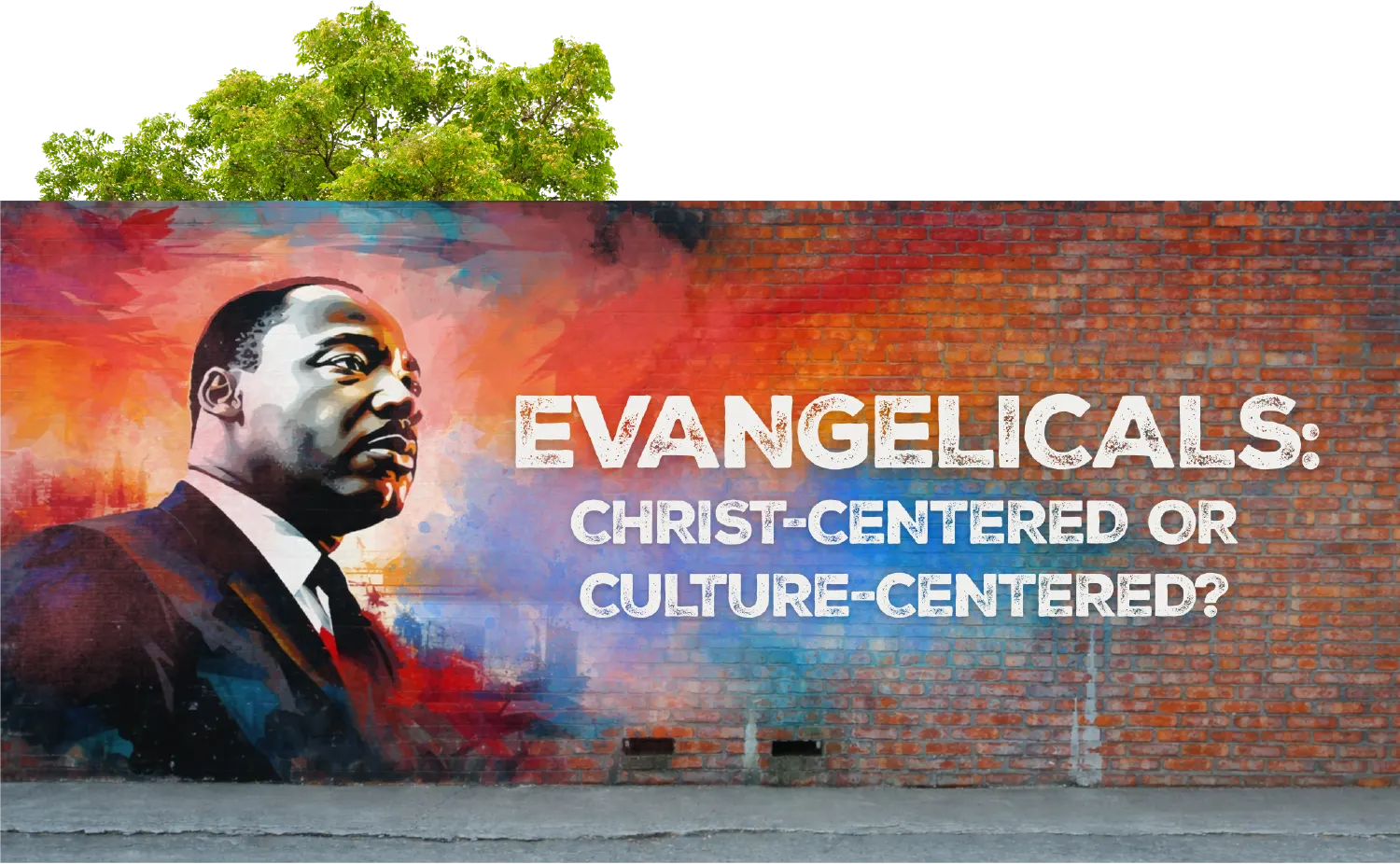
In considering Dr. Martin Luther King Jr.’s book, “Where Do We Go from Here: Chaos or Community?,” we need to present this question to us: where do we, as evangelicals, go from here: Christ-centered or cultural-centered?