

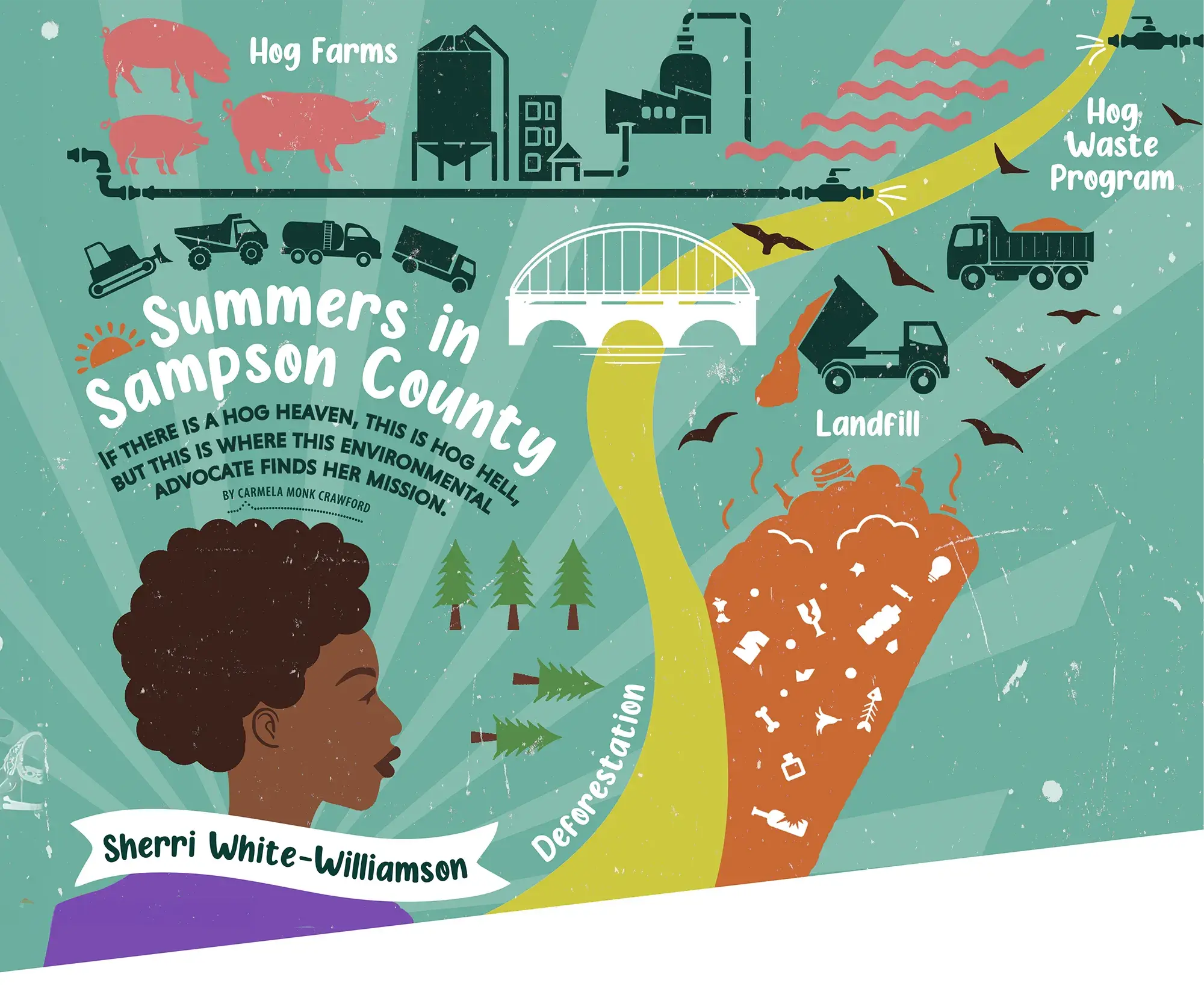
Long before she co-founded this outfit with friends from her Vermont Law School, White-Williamson, occasionally criss-crossed Sampson County with colleagues from the federal Environmental Protection Agency (EPA) on what she called “Toxic Tours.”
The tour passed by Concentrated Animal Feeding Operations (CAFOs) that densely dot the map of Sampson County. It also included the pink, foamy-looking, open-air “lagoons” filled with hog waste. The man-made mountains of the county landfill could be seen against the idyllic countryside. And, regulators and researchers got to see first-hand impact of the forest clearing operations connected to a wood-pellet manufacturing giant. This toxic tour-guide can rattle off sobering statistics about the area’s environmental threats:
- Sampson County is the second largest hog producing county in the United States.
- The Smithfield meat-processing plant in town can “process” 10,000 hogs a day.
- Sampson County is the number one turkey producer in the state, third or fourth in the nation.
- Sampson County has the state’s largest landfill, more than 1,300 acres.
- The landfill is the second worst emitter of methane in the United States.
- The landfill is the worst emitter of vinyl chloride (the same deadly chemical that spilled during a 2023 Ohio train crash).
- Fifty percent of the residential population uses well water.
White-Williamson, as a Sampson County native, used to work for the tobacco industry herself. She realized one day, while walking through her old neighborhood, there’s not one house where someone didn’t die of cancer here.
“It is not a coincidence that so many African Americans live near oil gas development,” according to a NAACP report, Fumes Across the Fenceline. “Historically, polluting facilities have often been sited in or near African American communities. Companies take advantage of communities that have low levels of political power. In these communities, companies may face lower transaction costs associated with getting needed permits, and they have more of an ability to influence local government in their favor.”
“Fumes” indicated that more than a million African Americans live within one-half of a mile of a natural gas facility, and that African Americans face elevated risks of cancer from toxic emissions in the air every year from natural gas processing plants. One million African Americans live in counties where their air safety, due to these emissions, is, by EPA standards, a notch or two above “concern.” The correlating health effects are linked to summertime asthma attacks for kids and for adults (at a far lesser rate), missed school and workdays, and emergency room visits.
That’s just the effects of the actual oil and gas refining and emissions. Environmental advocates like White-Williamson also track the effects that result from the related trucking, land use, or the myriad other environmental risks, such as water and soil impacts.
The scope of environmental impacts on black and brown communities is huge. White-Williamson said she could not contend with such a behemoth of an issue without prayer for personal strength and wisdom.
These problems can be so critical that they are seen and experienced in the very climate of black neighborhoods. For example, tree clearing in black neighborhoods makes them as much as 13 degrees hotter, according to National Geographic “Yes, the Environment Can Have Racist Effects Too.” The health and well-being of residents in these communities are tied to the ongoing risks associated with water contaminants such as in Flint, Michigan, or Jackson, Mississippi. Or, these effects are in the devastating reality of “Cancer Alley” in Louisiana where proximity to oil refineries whose collective emissions lead to cancer rates 50 times the national average in residents.
Northcarolinahealthnews.com, in 2021, cited a study regarding air pollution in a neighboring county to Sampson County, Duplin. Ninety-eight premature deaths result from air pollution, and 89 of those lives cut short are linked specifically, to the hog farm. According to Cleanaire North Carolina there are more than 2,000 large hog farms in the state, and they are disproportionately in black, brown, and low wealth communities.
“I’ve been talking with reporters about all kinds of stuff,” said White-Williamson, “and nothing ever seems to make it to a national level so that folks understand that environmental injustice is a real issue, not just in cities, but in rural areas, like where we come from, and even decision makers, I think, have a problem with conceiving or understanding that just because we’re rural that it doesn’t mean that we get dumped on all the time. With EJ communities, once you get one or two things there, then it’s kind of like you become a magnet for everything else.”
Nowadays, the young people are talking about “generational wealth,” says Paul Fisher, a resident of Snow Hill, North Carolina, and an active voice for residents who must contend with the environmental impacts of the area’s industry, in particular, for him, the GFL Landfill.
After a lifetime of work as a bricklayer, and a truck driver, the solid brick home Fisher crafted himself, the acreage holding fruit trees and a garden all stand as a testament to his management. He held onto his land by not incurring debt, and not having to sell, but the landfill threatens that nest egg. “It takes away from the value of the neighborhood,” Fisher said. “It has the tendency to affect how much money can pass to my children.”
When he returned to Snow Hill in the early 1970s, after going away to school, the landfill was a newer development, nevertheless he moved back, and has stayed through its expansions. Fisher contends with the truck traffic and the trash that often flies off the trucks and personal vehicles. Why there? Why back to the lot bordering the landfill?
“I grew up here,” Fisher said, pointing to the little brick, one-story, about 50 yards away. “The house next door was my mother and father’s house. I came back when they were getting a little age on ‘em. Most people don’t move back,” he said.
Yet, it’s unclear to him whether his own adult children would want to return. Who wants to inherit property that borders the county’s largest landfill, with its vultures, occasional bears, unbearable smell, and all of the unknowns in the soil and water? Thus, Fisher fights. He attends the local community meetings. He speaks to the press, and holds onto his property. The last part is difficult for some property owners who just want out.
GFL, the Canadian waste management company that operates the landfill, did not respond to questions regarding their corporate responsibilities to neighbors. Their “Green for Life” mission, however, may have started to live up to its name. A recent 86 degree day, found blue skies, a neatly manicured corporate drive, and amazingly, no odor.
“Well,” said Fisher, “we’ve been getting a lot of publicity about the landfill, and that’s mostly because of Ms. Sherri.”
“Claims that hog farms impact public health just don’t hold up,” wrote, Ray Atkinson, Senior Director of External Communications. Instead, Smithfield deflects by pointing to smoking and obesity as “correlating with mortality outcomes.” Besides, Smithfield added, neither Sampson, or Duplin Counties, though they account for 40% of the pigs raised in North Carolina, place “in the highest quartile in the state for mortality.”
Add to that, Smithfield cites a number of corporate initiatives, grant programs, apprenticeships, and food donations as evidence of their goodwill and local investment in the community and its residents. The company also recently donated $100,000 for the purchase of a bus to Ripe for Revival, a mobile food retail market that helps bring less than perfect produce to the community for “pay-what-you-can-prices.”
“They always say that,” White-Williamson countered, simply. Not to be distracted, she focuses on an end goal that’s past the gifts of turkeys and hams during the holidays, and discerns what she thinks is the less-than-transparent company spin on current pipeline installation. This work requires focus and determination. When she returned to the area to live from Washington, she decided to attend church with then Pastor, social justice advocate, and head of the North Carolina NAACP, William Barber. She said she needed to be a part of a community of faith that was doing something.
Start doing sustainable stuff, White-Williamson admonished. Think about what you’re using, and what you’re disposing of. These are little, sustainable steps. Can you donate to a local organization that is trying to help? Can you volunteer? Can you do the social media for them to bring attention to what is happening?
“But I think people need to start digging a little bit deeper and, and learning more about communities. You know, environmental justice is the buzzword. But what do you really know about environmental justice? Who is it really impacting? Do you have relatives in Alabama, South Carolina, or somewhere that may be getting this crap dumped on them? And you aren’t at least trying to raise the awareness? Whether from inside or outside? Or you?”