


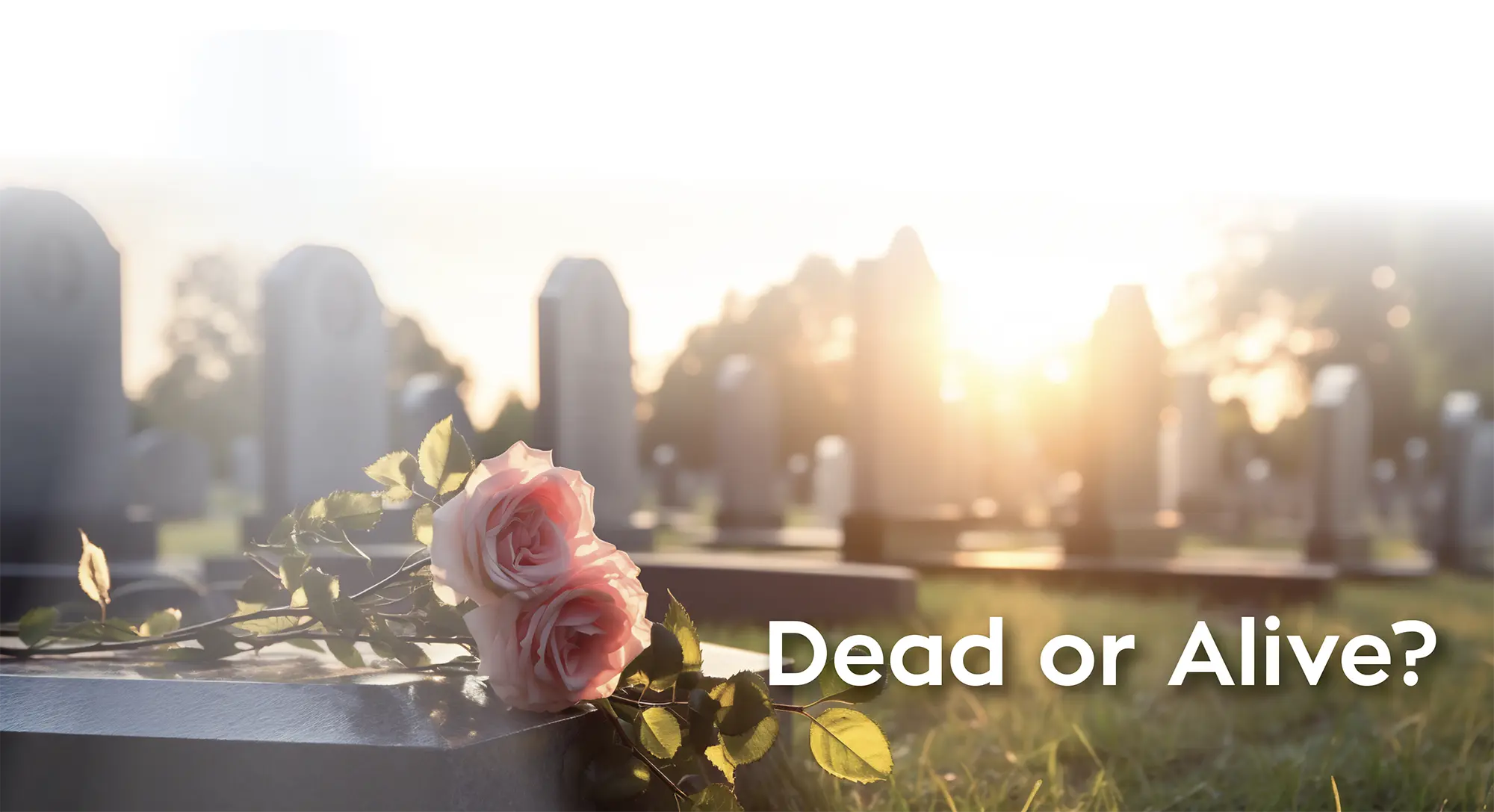


Verbal expressions and statements that “Mamma is in a better place,” or “Daddy is looking down on us,” are commonplace at many funerals and memorial services for departed loved ones. Yet, the Bible is very specific as to the condition of the dead.
Genesis 2:7 says, “And the Lord God formed man of the dust of the ground, and breathed into his nostrils the breath of life; and man became a living soul.” For Bible-believing Christians, this text clearly substantiates that man didn’t evolve from a “monkey” or “big bang” theory, but man was created by God.
“And God said, ‘Let us make man in our image, after our likeness: and let them have dominion over the fish of the sea, and over the fowl of the air, and over the cattle, and over all the earth, and over every creeping thing that creepeth upon the earth. So God created man in His own image, in the image of God created He him; male and female created He them’” (Genesis 1:26, 27).
The question then begs to be asked, “If God formed humanity in life, what happens to humanity in death?”
The answer to this question is rooted in the fact that the elements of dust and breath are both needed to create a living soul, and if you don’t have both elements, you cannot have a living soul as this is not an either/or provision, but a both/and requirement.
When one dies, Ecclesiastes 12:7 is clear that the physical body returns to dust and the spirit or breath returns to God who gave it. Because the spirit of God is what was breathed through humanity’s nostrils at one’s creation, (Job 27:3), the spirit of God is not to be confused and equated with the soul. The spirit of God or breath, not the soul, returns to God at death and the soul ceases to exist.
- return and haunt houses (Job 7:9-10)
- know what their loved ones on earth are doing (Job 14:12 21)
- remember or give thanks, (Psalm 6:5)
- praise the Lord, (Psalm 115:17)
- think (Psalm 146:4).
The solemn reality is that dead people are not alive, but dead.
Nevertheless, there is hope! At the Second Coming of Christ, those who have died or fallen asleep in the Lord at the time of their earthly death will rise first at this culminating, climactic event and eternally live with Jesus! (1 Thessalonians 4:16, 17). If the righteous dead transitioned directly to heaven at their earthly death, who would rise first at the Second Coming?
Consequently, there would be no need for Jesus to return to this earth to redeem the righteous dead. But we can rejoice in the fact that Jesus, the Lifegiver (John 11:25), will give life again to the righteous dead and they will be alive forevermore!
Dead or Alive? For those who love and live for Jesus, death is not the end! If they die and fall asleep in Jesus, there will be a resurrection of the righteous! ( John 5:28, 29). They will live again! Given this, perhaps a better title is “Dead, and for the Righteous, Alive Again!
