

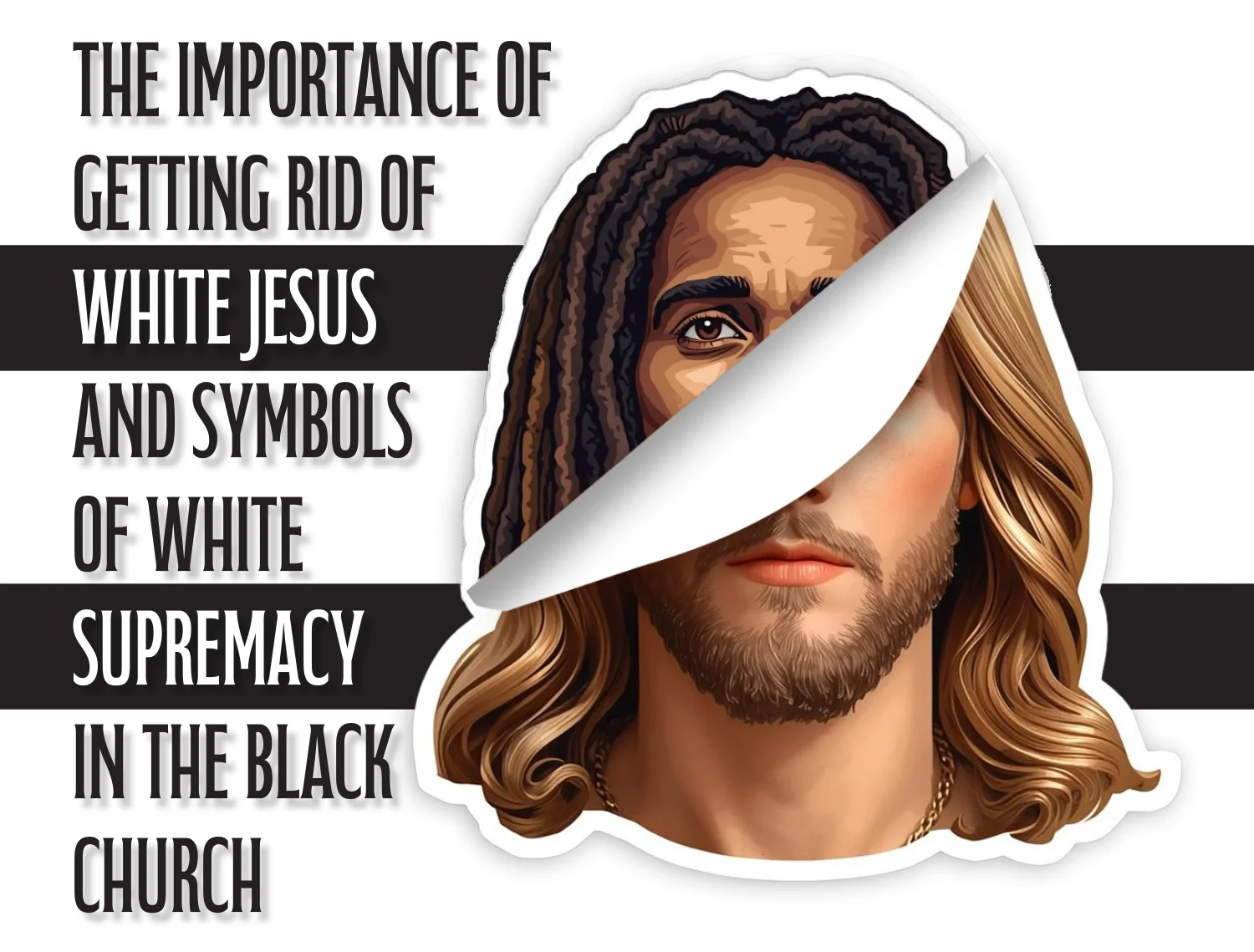
– Dr. C. Wesley Knight, Pastor of Revision SDA Church in Atlanta, Georgia
In 2020, during the height of the international protests against the senseless murders of black individuals such as George Floyd and Breonna Taylor, social justice activist, Shaun King tweeted, “I think the statues of the white European they claim is Jesus should also come down. They are a form of white supremacy.”
Now, blatant anti-black rhetoric is spewed by black and white pastors alike, contemporary Christian music artists and executives, and thought leaders and influencers. It is time to revisit the idea that white Christian iconography — visual images and symbols — must be discarded and not used within our churches. We need to be intentional in replacing such visual language and illustrations.
Such a proposal is not new, as churches like Trinity United Church of Christ and The Faith Community of Saint Sabina in Chicago, and Union Temple Baptist church in Washington D.C. provide clear examples of congregational leadership creating worship settings that highlight black biblical figures and black Christianity through physical architecture and iconography.
Today, we argue for the intentional removal of white Jesus and Eurocentric symbols from black religious spaces and the integration of black Jesus and black empowerment imagery as acts of theological reparation, communal restoration, and spiritual liberation. Further, we can outline practical strategies for black congregations to make this transformation through a term I have coined as VantaBlack Leadership. This means a leadership approach so bold, so absorbing of truth and history, that it leaves no room for the reflection of distortions.
For enslaved Africans and their descendants, the image of white Jesus was weaponized to equate whiteness with divinity, purity, and power, while associating blackness with sin, servitude, and savagery. Pastor Claudia Allen, author of the popular article, “Why White Jesus Must Go, The Image is Not Only Inaccurate — It’s Harmful,” explained in an interview with me:
“From the 3rd century Grecco-Roman period to Asian artists depicting Christ as Asian beginning in 1240, to Countee Cullen and Aaron Douglas’s ‘Black Christ’ during the Harlem Renaissance, to Warner Sallman’s ‘Head of Christ’ in 1940, every race of people has sought to present a picture of Jesus in a way that represents their culture. However, black artists have never claimed their depictions of Christ to be historically accurate representations, and they have never wielded those images as weapons to exclude other people groups from the body of Christ.”
Dismantling the use of white Jesus is not an attack on Christ but is an act of fidelity to the real Christ, who was born in a nation-state adjacent to the modern-day continent of Africa, lived part of his early life on the continent, and died a man of color.
While some may acknowledge the psychological and sociological effects of the representation of Christ and other biblical figures as white, theologically, there can be concerns about highlighting any physical depictions of Christ due to the second commandment, which admonishes us to avoid the creation of graven images or any likeness of anything that is in heaven above. However, Dr. Keith Burton, professor and theologian has stated,
“While the display of images can have theological implications, I don’t believe that images in and of themselves are inherently sinful. The second commandment has to do with intent — making an image with the purpose of assigning it divine status. This could very well apply to a car, a vase, a suit, or even a church building!”
Replacing Eurocentric depictions with black biblical imagery is therefore not about racial preference; it is about restoring balance to the theological imagination. Black Jesus reclaims the truth that God identifies with the oppressed (Luke 4:18), that divinity is not bound to whiteness, and that salvation history includes the African presence from Genesis to Revelation.
Audit the Visual Environment: Conduct a congregation-wide inventory of artwork, media, and literature that features white or Eurocentric imagery. Discuss as a church community which items perpetuate harmful narratives, and which can be replaced with more accurate depictions.
Partner with Black Artists and Theologians: Commission artists to create contextualized religious art, for instance commissioning murals of the Exodus led by an African Moses, or stained glass showing a dark-skinned Christ feeding multitudes. These collaborations merge theology and artistry to heal collective memory.
Educate through Sabbath School and Sermon Series: Develop study materials that explore the African presence in Scripture, from Egypt and Cush to Simon of Cyrene. Integrate works by black theologians like Delores S. Williams (womanist theology) and James Cone (black liberation theology).
Replace or Re-stain the Stained Glass: Just as architecture once reflected colonial power, reimagined sacred spaces can reflect divine justice. Replace windows and paintings that depict pale biblical figures with art that honors African and diasporic heritage. In other cases, re-stain existing stained glass to ensure biblical figures have various brown skin tones.
VantaBlack leaders within the black Church are those who:
- Refuse to center whiteness in theology or practice.
- Absorb the pain of historical erasure and transform it into prophetic action.
- Advocate for structural reform in black religious institutions — seminaries, publishing houses, media outlets — to ensure that future generations inherit a decolonized faith.
- Lead congregations toward visual, doctrinal, and cultural authenticity rooted in the gospel of liberation.
Black church leaders should unashamedly embrace such a position because it is moral. In a recent interview, religious thought leader and consultant Marquis Johns explained it this way:
This is not merely aesthetic; it is pastoral care, psychological protection, and a refusal to reinforce the racial hierarchy embedded in white iconography.”
This leadership requires courage, for it challenges the aesthetic comfort of long-standing traditions. Yet, it is precisely the kind of leadership that mirrors Christ’s own ministry, which was disruptive, truth-telling, and emancipatory.
“Churches and faith-based organizations are, amongst many things, educational spaces —this means that the imagery, iconography, artwork, media, literature, ideologies, and implicit or explicit ethos that is embedded in (mis)representation have curricular influence on the identities and theologies of those who are exposed to them.”
The journey to decolonize iconography is ultimately a journey back to truth, a truth that reveals a God of justice whose skin glows like burnished bronze and whose love is as deep and unyielding as VantaBlack itself.