



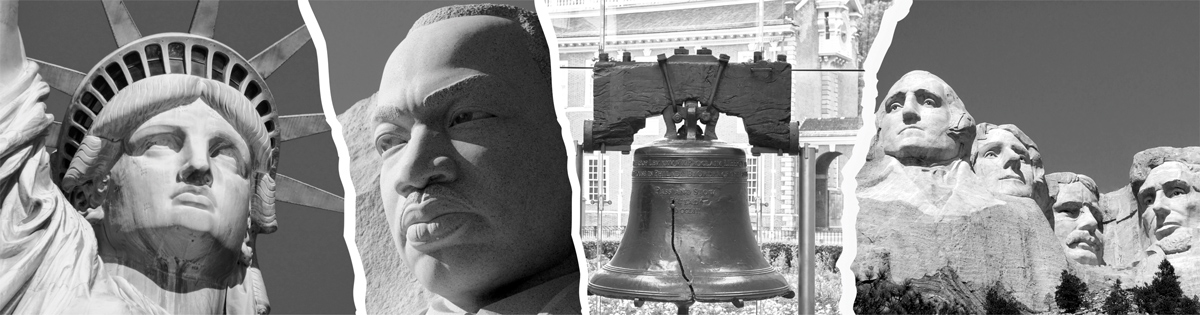

 n crisscrossing the Home of the Brave and the Land of the Free, Americans take pictures of national and historic symbols. On Liberty Island, the Statute of Liberty Enlightening the World boasts as the “universal symbol of freedom and democracy.” In Philadelphia, the Liberty Bell represents a symbol of “American freedom and democracy.” Mount Rushmore in South Dakota identifies four U.S. Presidents (George Washinton, Thomas Jefferson, Theordore Roosevelt, and Abraham Lincoln) who led the country in turbulent times. Americans’ contemplation with symbols produces iconic images of freedom and leadership.
The Martin Luther King Jr. Memorial in Washington, D.C. exemplifies Dr. King’s advocacy for freedom, equality, and justice. In Montgomery, Alabama, the National Memorial for Peace and Justice names more than 4,440 black people murdered in racial terror lynchings from 1877-1950. Americans’ contemplation with symbols contrasts ideals instead and reality.
Yet, the 9/11 attacks focused on destroying the symbols of democracy (U.S. Capitol), defense (Pentagon), and economic power (Twin Towers). The attack served to elevate American Patriotism, and unfortunately led many Americans to demonize Muslims as terrorists, rather than correctly recognizing the actors as extremists, and dissenters with respect to Islam. In the 2023 Hate Crime Statistics, the FBI reported that the number of anti-Muslim hate crimes increased from 28 to 481 incidents in 2001 and has not returned to the 2000 or earlier levels. Americans’ contemplation with symbols provides a swift and visceral retaliation that can lack reasoning when attacked.
Speaking of symbolism and prior to the 2024-2025 school year, Oklahoma State Education Superintendent Ryan Walters required all schools to incorporate the Bible and the Ten Commandments in their curriculums from grades 5-12. Walters’s shared, “The Bible is a necessary historical document to teach our kids about the history of this country, to have a complete understanding of Western civilization, to have an understanding of the basis of our legal system.”
Walters fails to identify whether it’s the entire Bible or portions of the Bible that should be infused into the curriculum. The Bible speaks to how we treat immigrants (Deuteronomy 10:19); sexism and religious oppression (Galatians 3:28), ableism (Leviticus 19:14), ageism (I Timothy 5:1-2), classism (James 2:1-4), and racism (Romans 2:11). Walters views the Bible as a foundation for America’s history and legal system, but not how we treat one another.
In doubling down on the Bible as a foundation for America’s history and legal system, Walters recently announced a new Office of Religious Liberty and Patriotism. The office will “serve to promote religious liberty and patriotism in Oklahoma and protect parents, teachers, and students’ abilities to practice their religion freely in all aspects. The office will also oversee the investigation of abuses to individual religious freedom or displays of patriotism.”
This focus on symbols is more associated with ideals versus reality, alternative facts versus veracity, and ideology versus God’s word; especially when it comes to treating one another fairly and equitably.
