

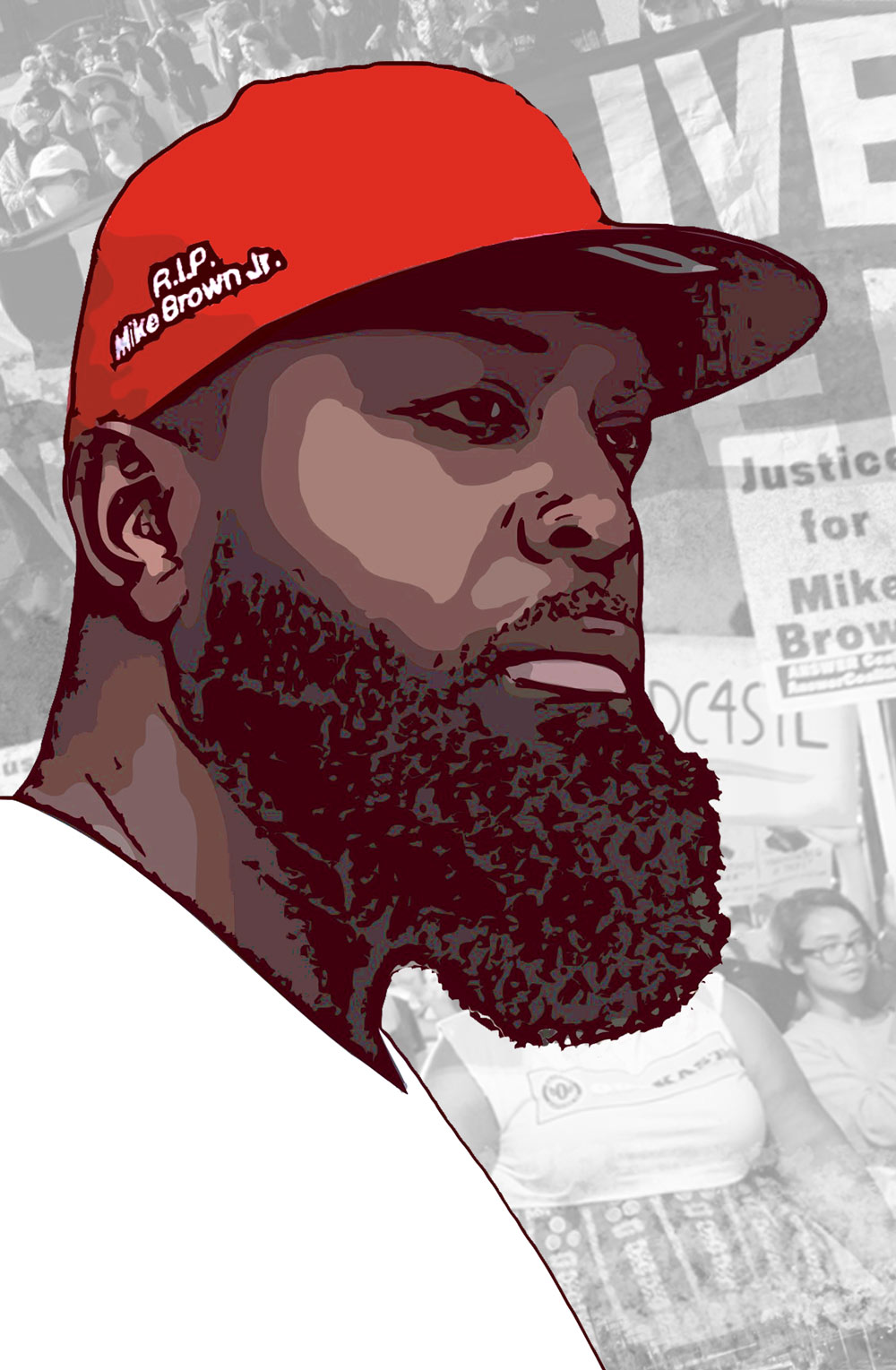

Brown Sr. has been the grand marshal at the Ferguson Juneteenth Parade, and a frequent panelist discussing the killing. He’s in front of the cameras at press briefings, meetings, exhibits, and ribbon cuttings. He’s the star of a documentary. Even at church, people sidle up to him for selfies.
He and his wife sit in solace with others who have lost loved ones — reliving that moment again and again to support them. They relive the moment in defiance of the narrative brokers who would paint Michael Jr. in a certain way. To the elder Brown, this is not a life work, but a life sentence.
Ferguson was already a tinder keg before Brown Jr. met his untimely death that hot summer day. Ferguson essentially operated a notorious shakedown of its residents for minor traffic offenses, raking in more than $2 million in fines each year, said Patricia Washington, a former city government aide, but now the public face of the Ferguson Police Department.
Ten years ago, majority white police forces clashed with the majority black community. It was no surprise that black people were more likely to be searched after being stopped, though the searches were 26% less likely to uncover anything illegal, according to an Associated Press report. Black people spent more time in jail and were the ones who suffered bites at the jaws of the police dogs. For the same types of offenses, black people in Ferguson were much less likely than their fellow white residents to have their cases dismissed in court by the white judge. Driving and Walking While Black, was definitely an unspoken reality, said Karen T. Louis, a local attorney.
Brown Jr., affectionately called “Mike Mike,” had just graduated from high school, and at their celebration dinner over Chinese food, he prophesized to his dad and his step- mother, Calvina: “The world gonna know my name. Ima shake the world,” he said, she recalled. “I may have to go away for a while, but Ima come back and heal my city.”
Two weeks later, in a scuffle still in dispute in the minds of the family, community, the court system, and the federal justice department, Ferguson police officer Darren Wilson shot Brown Jr. The police left his cooling body in the middle of Canfield Street for four and a half hours.
“Those four and a half hours are the reason we [are] here now,” Brown Sr. said in an interview with Message last month.
“My wife is like, ‘You’re gonna have to say something,’” recalled Brown Sr. “‘I don’t know what you’re going to say, but you have to say something because they don’t think this boy got a daddy. You’re gonna have to figure out some words real soon, and you go out to address this world, and let them know you’re standing up for your son.’ And I think at that moment, that’s when it hit. And, yeah, they ain’t been able to shut me up since.”
Though he struggled spiritually, wondering where God was in the midst of all the evil, Brown Sr. said he’s clear that he would not be here now if it weren’t for Him. Brown, Sr. needed to forgive himself. In those agonizing moments of reflection, he just wondered was there anything he should have — could have, would have — done to save his son’s life. He found that forgiveness for himself, and coaches others to find the peace that comes from forgiving oneself. He’s also confident that God understood his suffering and anger. Mike was murdered. Mike had promise. Mike was loved.
The killing of Michael Brown Jr. stands as a pivotal moment in the modern awareness of racialized policing practices. The prevailing routine: white cop shoots black, male, unarmed teen; white cop suffers little consequence, is no longer necessarily routine.
Black Lives Matter became a rallying cry and a point of contention. Dashcams and body cam protocols, when followed, now verify disparate stories.
In Ferguson, specifically, a lot has changed in 10 years according to the Associated Press, in an article tracking the progress after a federal investigation and consent decree. Ella Jones, a former city council member became the first black mayor in 2020. And the city council that had one black member in 2014, had four in 2020. There is now diversity in the police ranks too. Systemically, the justice department investigation and the resulting consent decree helped dismantle the traffic fine cash cow. Revenues from fines and fees fell from $2 million, to about $97,000 annually, freeing lower income people from a financial trap. New buildings, such as the Urban League Center, cropped up and businesses with jobs materialized. National organizations emerged with the goal of better tracking police interactions, especially ones that end in fatalities. Fatalencounters.org is one such outlet.
“We try to document all deaths that happen when police are present or that are caused by police: on-duty, off-duty, criminal, line-of-duty, local, federal, intentional, accidental — all of them.”
“Well, the type of change we would have wanted to see,” said Calvina Brown, “was that Mike was the last. Unfortunately, that has not happened.”
For the Browns, the enduring reputation of abusive policing means there is still a lack of trust. And the hurt and grief — wherever it comes from — is still a problem. “For us, we focus more on changing the narrative for grieving families. We focus on removing grief, loss and trauma,” she said.
The Browns built their non-profit organization, Chosen for Change, to reach what they estimate as 57% of the black community in the St. Louis area suffering from grief, trauma and loss in some way. Their days are spent with men in the father grief group, Chosen Fathers; or Mothers of Angels for grieving mothers, or support groups for whole families. They give them tools to cope, heal, reinvent themselves, and relaunch into the world, said Calvina Brown. Their work is literally talking people off the ledge, staying on suicide watch, and keeping people from shooting up the place.
“We try to give these families, you know, words of encouragement, and stay in touch, and, you know, be able to pray with them… be an ear for them, you know,” said Brown Sr., … Late night calls two, three in the morning , when it really hits home, when they realize that their child is not coming home, and they need someone to talk to.”
